From spacesuit gloves to a T-shirt - the story of Outlast® technology

Outlast® technology has NASA heritage. In the 1980s, Johnson Space Center in Houston was looking for a way to improve the insulation of spacesuit gloves and, under its programme for small businesses (SBIR), commissioned research from Triangle Research and Development Corporation of North Carolina. Triangle sealed phase change materials in microcapsules and built them into fabric. The patent rights for fibres and fabrics were later bought by a Colorado company, which in 1997 took the name Outlast Technologies. Today the same physical principle is at work in bedding, footwear, racing drivers' base layers and THE IQONE T-shirts.
Below is the whole story, step by step, with sources. And if you'd rather know straight away what this technology does day to day, head to Thermoregulation in clothing.
Timeline at a glance
- 1980s. Johnson Space Center (NASA) signs an SBIR contract with Triangle Research and Development Corporation for better insulation in spacesuit gloves. Triangle demonstrates a glove liner containing microencapsulated phase change material.
- Approx. 3 years after the contract ends. Gateway Technologies of Boulder, Colorado, buys the exclusive patent rights for commercial fibres and fabrics.
- 1997. Gateway changes its name to Outlast Technologies, Inc.
- 2003. Socks with the technology arrive on the market. By then, Outlast duvets, pillows and mattress protectors are also on sale.
- Today. Outlast® operates from Heidenheim in Germany, and the technology is at work in clothing, footwear, helmets, bedding and chairs.
The problem: a glove that has to cope with extremes
An astronaut in a spacesuit has one point of contact with the outside world that simply cannot fail: the hands. The glove has to be thin enough to handle tools, yet still protect against the cold and heat that swing abruptly in space. Thicker insulation means clumsier hands.
So NASA was looking for a material that would not only insulate, but also even out temperature swings by itself. According to NASA Spinoff, in the 1980s Johnson Space Center signed an SBIR contract with Triangle Research and Development Corporation precisely to improve the insulation in spacesuit gloves (NASA Spinoff).
The solution: phase change material in microcapsules
Triangle, based in Research Triangle Park, North Carolina, already had experience with phase change materials from earlier work for the US Air Force. A phase change material is a substance that absorbs or releases heat as it changes state, from solid to liquid and back again, while its own temperature stays the same.
The key idea was to enclose this substance in microscopic capsules. That made it possible to build it into fabric: the material melts and solidifies, but it doesn't leak. Triangle demonstrated a spacesuit glove liner that stabilised temperature. According to NASA, the solution wasn't used on missions at the time. It made its name here on Earth instead.
Exactly how this transition works, and why ice keeps a drink cold on the very same principle, is explained in How PCM works.
From patent to the Outlast brand
Tech Briefs, a magazine that covers technology transfer from NASA, reports that roughly three years after the NASA contract ended, the exclusive patent rights for commercial fibres and fabrics were acquired by Gateway Technologies of Boulder, Colorado, founded by Ed Payne and Bernard Perry. In 1997 Gateway changed its name to Outlast Technologies, Inc. (Tech Briefs).
The first applications stayed close to the original: gloves and footwear. Over time they were joined by socks, underwear, T-shirts, trousers, jackets and hats, as well as bedding: duvets, pillows and mattress protectors. Tech Briefs mentions, among other things, socks that came onto the market in 2003 and concept leather car seats using the technology.
Today Outlast® is headquartered in Heidenheim, Germany, and describes its own technology as originally developed for NASA (Outlast).
Heritage, not a sticker
“NASA heritage” is shorthand that's easy to misread, so we'll say plainly what it means. It means that the working principle - phase change material in microcapsules built into fabric - was developed in research for NASA spacesuit gloves. It doesn't mean that NASA designed our T-shirt, nor that the T-shirt was ever in space.
The technology has moved on since then. Today Outlast writes about a wax, usually based on rapeseed oil, sealed in microcapsules and built into the fibre or applied to the material (Outlast, How it works). The physical principle has stayed the same: collect heat when there's too much of it, and give it back when it gets cooler.
Where Outlast is at work today
All the applications share the same common denominator: a place where the body meets the material and where the temperature changes often.
- Sleep: duvets and bedding that collect excess heat at night.
- Motorsport: Walero base layers for racing drivers, worn under the race suit.
- Office: chairs you sit on for hours at a time.
- Everyday clothing: underwear, socks, outdoor clothing and clothing for women going through the menopause, which NASA Spinoff lists as one of the newer applications.
A new chapter: PCM in a cellulose fibre
When we were designing THE IQONE, we wanted a T-shirt you put on in the morning and take off in the evening, without giving layers a second thought. So we combined two things: Outlast® viscose with PCM microcapsules built into the fibre, and Tencel™, which is smooth to the touch and handles moisture well.
The T-shirt is 56% Tencel™, 37% Outlast® viscose and 7% Lycra®, so 93% of its fibres come from wood cellulose. We make it in Poland. The capsules are part of the fibre, not a coating, so they don't come off in the wash. We write about the fibres themselves in Materials of natural origin instead of synthetics.
What this story means for you
An astronaut's glove and an all-day T-shirt share a problem: the temperature next to the skin keeps changing, and there's no way to change clothes. A phase change material collects excess heat when there's too much of it and gives it back when it gets cooler. In practice, you feel it wherever you change your surroundings or your pace:
- in a heated car and a chilly car park, on a long journey,
- under a jacket or blazer, as you go in and out,
- on the trail, where climbs alternate with stops,
- working in the field, for hours on end without a change of clothes.
According to Outlast® data from tests by the C. Russ - INSIDE CLIMATE laboratory in Munich, there is up to 50% less moisture in the microclimate next to the skin than with materials without PCM. What this figure means is explained in Up to 50% less moisture - where the figure comes from.
Which T-shirt
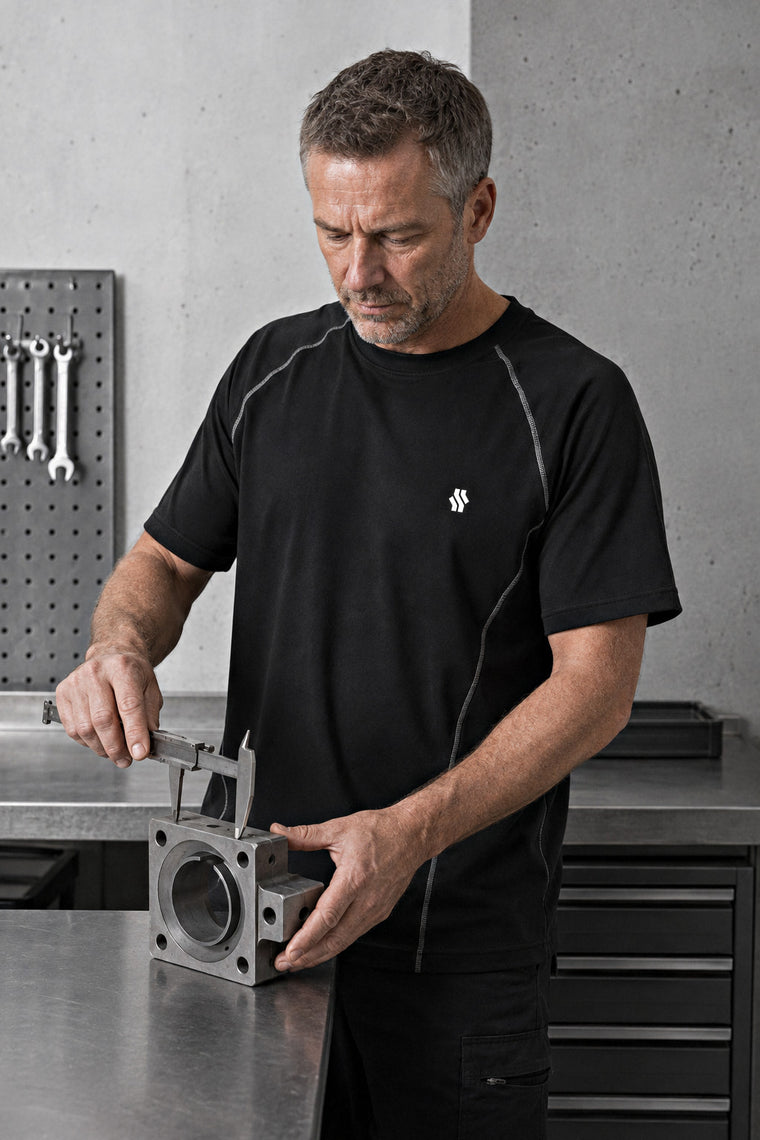
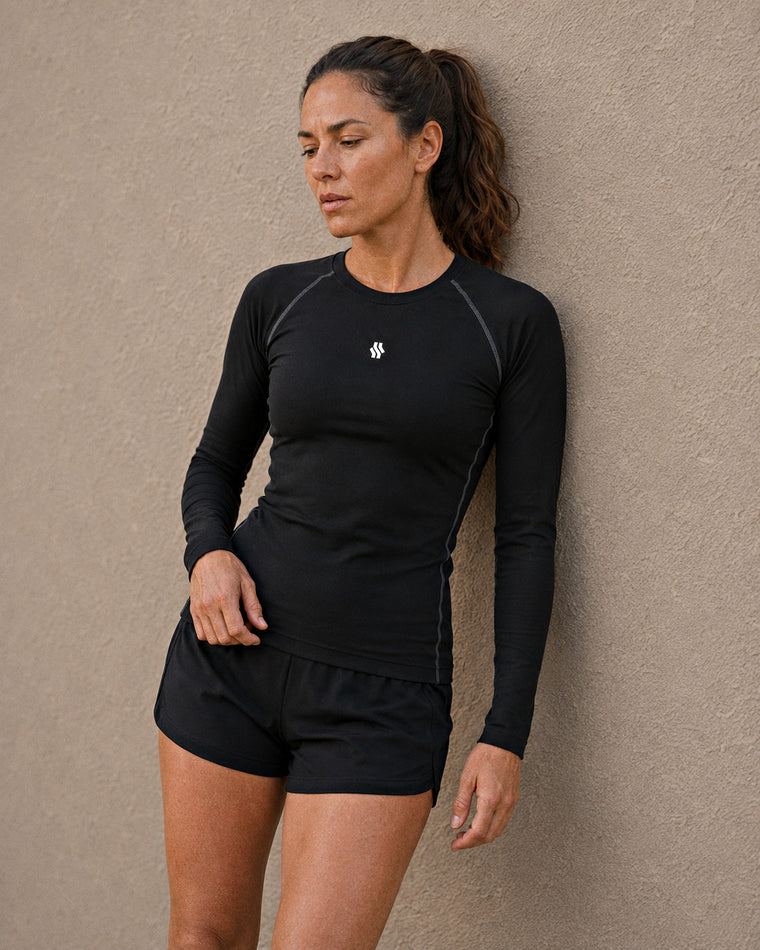
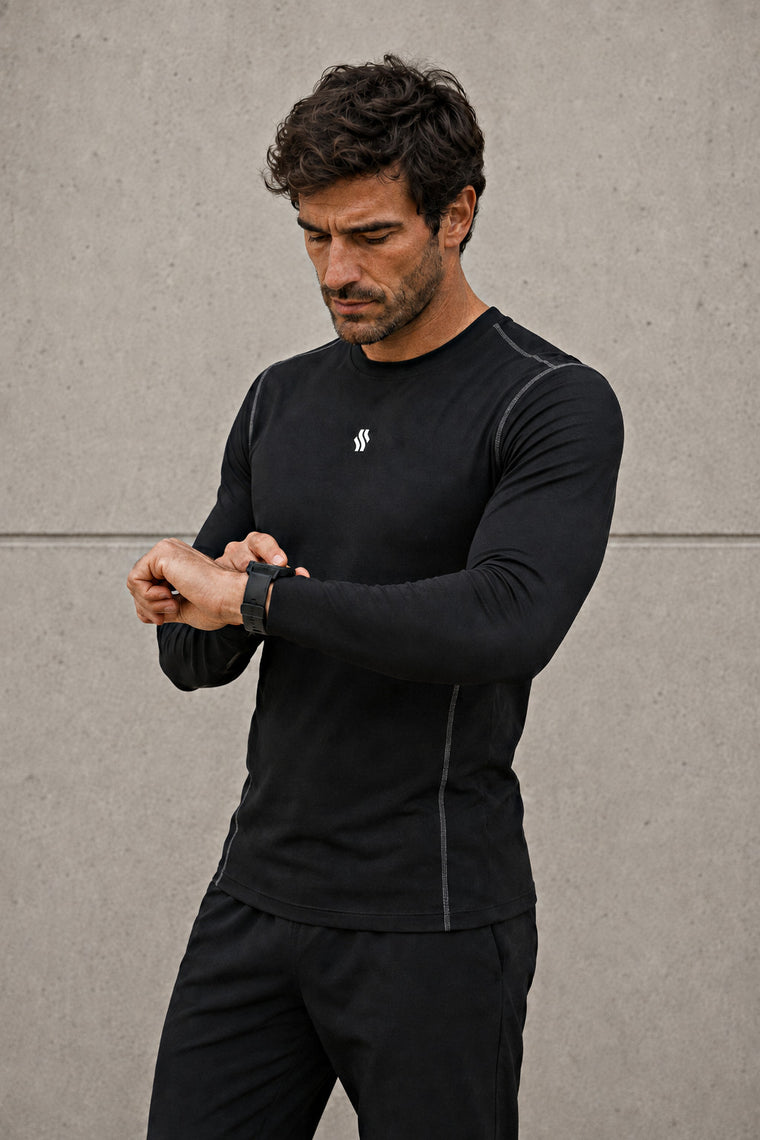
For everyday wear and the trail: Sport Tee Women's and Sport Tee Men's. For working in the field: Worker and Worker Longsleeve.
Sources
- NASA Spinoff: Feeling Hot, Staying Cool (Johnson Space Center, SBIR contract with Triangle Research and Development Corporation, spacesuit gloves, today's applications)
- Tech Briefs: Covered in Comfort (Gateway Technologies, name change to Outlast Technologies in 1997, first products)
- Outlast®: Thermo-Technology (Heidenheim, technology originally developed for NASA)
- Outlast®: How it works (wax in microcapsules)
- Outlast®: FAQ (up to 50% less moisture, C. Russ - INSIDE CLIMATE tests)
Author: THE IQONE Team. Updated: 28.10.2026.
Read next
Clothing that reacts for you.
Outlast® PCM microcapsules absorb excess heat and release it when it gets cooler. One layer from morning to night.